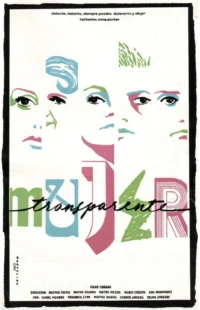
This analysis of Mujer Transparente focuses on a film composed of five interconnected narratives that trace women’s experiences in Cuba from the 1970s to the onset of the Special Period. Through a fragmented structure, the film examines the interplay between institutional discourse, intimate life, and female subjectivity.
Analysis of Mujer Transparente (Synthetic Reading)
Summary of gender-related elements
Mujer transparente offers a journey through women’s experience in Cuba from the 1970s to the onset of the Special Period, focusing on the gap between the equality proclaimed by socialist discourse and the persistence of patriarchal structures in private life. Through five women situated at different stages of their lives, the film shows how marriage, motherhood, and work remain organized around an ethic of female sacrifice, in which the double burden, the renunciation of conflict, and invisibility continue to function as naturalized norms.
The female body appears as a space of control, exhaustion, and resistance. Women’s desire oscillates between internalized repression, moral guilt, and rebellion, never achieving full liberation. Rather than constructing heroines or victims, the film presents subjectivities shaped by historical, emotional, and social contradictions, revealing an incomplete form of female emancipation marked by the constant tension between duty, desire, and survival.
Across the five shorts, the film exposes a persistent pattern: the female emancipation promoted by the socialist state was effective in granting access to work, education, and public participation, but it failed to transform patriarchal structures within the domestic, emotional, and symbolic spheres. Marriage, motherhood, the body, and desire emerge as sites of tension where the double burden, imposed silence, guilt, and invisibility endure. From the woman who sacrifices herself without protest, to the one who represses her desire, the one who critically reflects on love, the one who rebels through the body and art, and finally the one who confronts the moral and economic collapse of the 1990s, the film presents multiple forms of intimate resistance within a system that offers no clear exits.
The contrast between institutional language and the protagonists’ inner voices runs throughout the film: radio broadcasts, slogans, and official discourse invade the domestic sphere but fail to name these women’s lived experience. The political dimension is not articulated through slogans, but through silence, thought, the exhausted body, and affective memory. Mujer transparente does not propose solutions or alternative models; its critical force lies in showing that a country’s history is also written in women’s intimate lives, where ideology falls short and the promise of equality proves incomplete.
Summary of discourse analysis elements
The film is structured around a fracture between official discourse and the protagonists’ intimate experience. The constant presence of radio broadcasts, political slogans, and institutional vocabulary introduces a public language that invades the private sphere, yet proves incapable of naming the women’s emotional reality. In contrast to this omnipresent discourse, the film privileges interior monologue, voice-over, and silence as spaces of critical enunciation.
The political dimension is not expressed through direct confrontation, but through the contrast between what is proclaimed and what is lived. Female interiority becomes an alternative discursive territory, where thought, irony, and memory expose the fissures of the system. Silence does not function as an absence of speech, but as the accumulation of a discourse that finds no place in the public sphere.
Summary of sociolinguistic analysis elements
Mujer transparente reflects the coexistence and evolution of multiple registers of Cuban Spanish across the decades spanned by its five stories, mirroring the historical and subjective progression from Isabel to Laura. In the early shorts, an institutional, bureaucratic, and repetitive register predominates, associated with state discourse internalized and reproduced within the domestic sphere, coexisting with a colloquial mode of speech marked by domestic metaphors, humor, and irony. As the film unfolds, this language fragments and becomes increasingly strained: cultivated registers linked to women educated before the Revolution emerge, along with introspective modes of thought and, ultimately, a form of speech permeated by disenchantment, doubt, and the loss of ideological reference points characteristic of the onset of the Special Period.
This superimposition and transformation of registers reveals a society in which languages do not truly dialogue with one another, yet are progressively worn down by time. While the State maintains a fixed and self-sufficient rhetoric, male characters reproduce learned formulas without questioning them, and women articulate their experience through a language that becomes ever more conscious, critical, and fractured. From Isabel’s functional silence to Laura’s reflective monologue, language becomes a gauge of historical exhaustion and a site of intimate resistance: the less effective official discourse proves at naming reality, the greater the force of the female voice as a space of memory, lucidity, and everyday survival.
The following section develops a detailed analysis of the film. This examination makes it possible to observe how the different thematic and discursive axes are progressively articulated, taking into account the narrative variations and the transformations that occur throughout the work as a whole.