
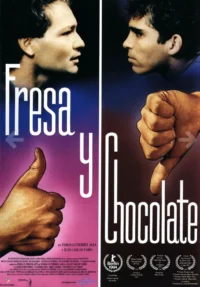
Fresa y Chocolate film analysis focuses on the construction of an interpersonal relationship that functions as a space of confrontation and mutual learning within a context marked by ideological intolerance and moral surveillance. Through the bond between its protagonists, the film explores mechanisms of exclusion, the rigidity of normative thinking, and everyday forms of social control in 1990s Cuba. Without resorting to overtly didactic discourse, the narrative articulates a critique of ideological homogenization through dialogue, irony, and the gradual transformation of individual perspectives, situating personal experience within a broader social framework where difference—political, cultural, and affective—becomes a site of friction and collective reflection.
Fresa y chocolate film analysis (synthetic reading)
Summary of gender-related elements
The analysis of gender elements in Fresa y Chocolate focuses on the ways in which the body, desire, and masculinities operate as sites of confrontation with the normative ideal of the new man promoted by the Revolution. The relationship between Diego and David reveals the incompatibility between a disciplined, austere, and ideologically monitored masculinity and other forms of male identity shaped by sensitivity, irony, and affective freedom. The film does not reduce the question of gender to sexual orientation, but rather articulates it as a political and cultural problem that traverses the body, behavior, and language.
From this perspective, the body becomes a space of critical enunciation. Diego embodies a dissident masculinity that subverts hegemonic codes by combining a virile appearance with gestures, affects, and practices traditionally associated with femininity, while David represents a body constrained by ideological morality, whose gradual transformation exposes the fragility of the normative model. Through this inversion of roles, the film proposes the possibility of imagining non-disciplined masculinities, open to doubt, tenderness, and desire, where affective experience functions as a path toward inner emancipation.
Summary of discourse analysis elements
The discursive analysis of Fresa y Chocolate highlights the confrontation between two modes of language that condense opposing visions of the Revolution and of the nation. On the one hand, the institutional speech reproduced by David is characterized by the repetition of ideological formulas, a normative lexicon, and a performative function oriented toward obedience and belonging. On the other hand, Diego’s discourse introduces a heterodox, cultured, and ironic form of speech that restores to language its critical, creative, and affective capacity, thereby dismantling the rigidity of official discourse.
The film turns dialogue into the primary space of conflict and transformation. Conversation, sustained through listening and exchange, replaces frontal confrontation as a political gesture. Through irony, cultural citation, and the resignification of insult, dissident discourse erodes revolutionary solemnity and reveals the dependence of power on that which it excludes. In this process, language ceases to function as an instrument of control and becomes a space of subjectivation, where the relationships between ideology, identity, and lived experience are reconfigured.
Summary of sociolinguistic analysis elements
From a sociolinguistic perspective, Fresa y Chocolate focuses on the materiality of speech and on the concrete uses of Cuban Spanish as expressions of identity and affectivity. At this level, Diego’s language is fundamental: his way of speaking articulates a deeply Cuban register, shaped by irony, humor, verbal sensuality, and a strong cultural charge. His lexicon, affective modulations, and manner of appropriating language construct an oral expression that stands in opposition to the rigidity of institutional speech and transforms conversation into a space of closeness, complicity, and recognition.
Diego’s speech incorporates cultural references, affective turns, and a distinctive musicality that point to a lived and embodied sense of cubanía, rather than to an abstract ideological identity. In contrast to normative language, his word unfolds as experience: it names desire, friendship, and loss through emotion and cultural memory. In this sense, language does not function as an instrument of social regulation, but as a space of symbolic belonging, where the popular, the cultured, and the intimate intertwine to produce a form of communication that is profoundly human and situated.
Below, the detailed analysis of the film is presented. This progression makes it possible to observe how the different thematic and discursive axes that run through the film are articulated in a gradual manner, taking into account both narrative variations and the transformations that occur throughout the work as a whole.